The InterPositive Deal Solves the Last Problem in the Pipeline. The Industry Should Be Solving the First.
Netflix got the philosophy exactly right — and applied it at precisely the wrong end of the pipeline.

This is a companion piece to “The Death of Impossible.” That piece examined what the new technology can do. This one asks what it means for the people running the organizations — and the org charts they are defending.
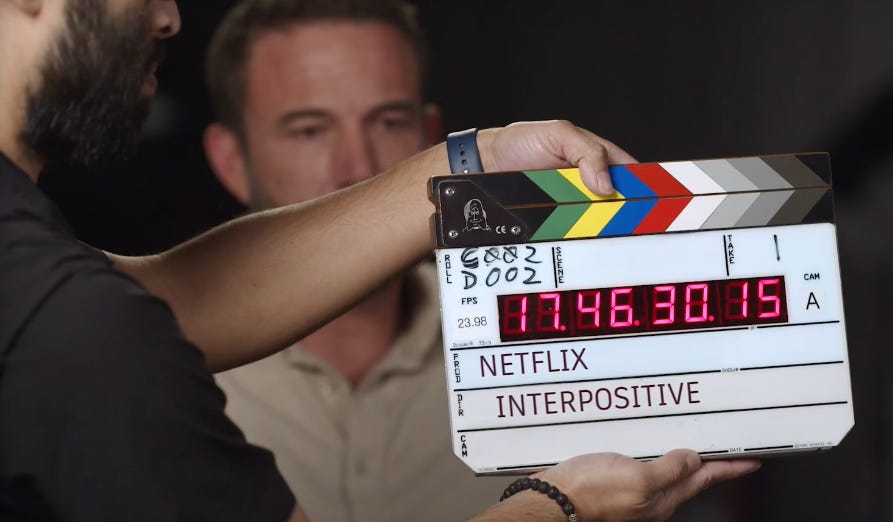
On Thursday, Netflix acquired InterPositive — the AI filmmaking company that Ben Affleck founded in 2022 and kept in stealth mode for three years. The deal was announced quietly. The industry response was immediate and revealing: a mixture of anxiety about what it signals, relief that a filmmaker rather than a tech company built it, and the particular kind of confusion that greets a move whose significance everyone senses but nobody can quite articulate.
Let me try to articulate it — and then explain why the deal, important as it is, answers a smaller question than the one the industry actually needs to be asking.
Affleck’s stated thesis for building InterPositive is one I recognize immediately, because it is the same thesis I have been developing from the production executive’s chair: that the irreplaceable thing in filmmaking is judgment. Not craft, not technical execution — judgment. “The kind,” as Affleck put it in his statement, “that takes decades to build, experience to hone, and that only people can have.” InterPositive was built to protect that judgment by giving filmmakers AI tools purpose-built for the creative process — trained on real production data, constrained to enhance rather than override creative intent, focused on the technical problems of post-production rather than on replacing the humans who solve them.
This is exactly right as far as it goes. The philosophical premise is sound. The execution — a 16-person team of engineers, researchers, and creative executives building proprietary models trained on real soundstage data — is serious and credible. Netflix acquiring it rather than licensing from OpenAI or building internally is a meaningful competitive move: the technology becomes exclusive to Netflix’s creative partners, a proprietary production capability that rivals cannot access.
And yet. InterPositive is a post-production tool. It makes the finishing end of the pipeline smarter. It addresses continuity problems, lighting adjustments, background replacements — the technical problems that arise when you are working with footage from a production that has already happened. It is, in the precise sense I want to use here, a smarter ratchet. It does not challenge the ratchet’s existence. It does not ask whether the ratchet should still be the organizing principle of how studios make content.
That is the question this piece asks. And the Netflix deal, arriving the day I sat down to write it, turns out to be the perfect illustration of why it needs asking.
Here is the thought experiment. You have a blank page, a serious budget, access to every technology now available to the industry, and — crucially — no legacy structure to protect. No existing department heads whose roles you are awkwardly trying to preserve. No guild agreements negotiated around a pipeline that no longer reflects creative reality. No physical infrastructure representing sunk capital in a workflow that is becoming obsolete.
You are not optimizing an existing studio. You are designing one from first principles, organized around what the technology actually enables rather than around what the technology of 1970 required.
What do you build?
I have spent the better part of three decades working inside the existing structure — as a producer, as an executive, as the person responsible for making the legacy pipeline function under conditions it was never designed to handle. I know what it does well and I know what it costs to maintain. And I want to argue here that the traditional four-phase studio model — Development, Production, Post, Distribution — was never designed around creative logic. It was designed around the cost of being wrong. When you understand that, you understand why AI changes everything about the organizational structure, not just the tools within it.
Part One:
Why the Pipeline Is Shaped the Way It Is
Nobody sat down in 1950 and designed the Hollywood production pipeline as a creative system. It evolved as a solution to a specific economic problem: the catastrophic cost of reversing decisions after they had been implemented.
Consider the logic of each phase transition. Development ends and Pre-Production begins when the script is locked — not because the script is perfect, but because opening it back up after you have hired a production designer, scouted locations, and begun pre-building sets costs more than living with an imperfect script. Pre-Production ends and Production begins when the shooting schedule is locked — not because every creative question has been resolved, but because the cost of the crew standing idle while creative decisions are relitigated makes resolution artificially urgent. Production ends and Post begins when principal photography wraps — not because the story is fully understood, but because the actors have been released, the sets have been struck, and going back to capture anything you missed requires a budget conversation that nobody wants to have.
Each phase is a ratchet. It clicks forward and does not click back. Every gate in the pipeline exists not to improve the work but to prevent the organizational system from having to absorb the cost of reversing decisions that have already generated downstream commitments.
The studio structure is a solution to a problem that is being solved by technology. The organizational form will follow.
The creative damage inflicted by this ratchet system is visible to anyone who has spent time in the edit bay trying to fix a structural problem that was identified in the writer’s room three years earlier but could not be addressed because production had already committed to the locations, the cast, and the schedule. It is visible in the post-production overruns that almost every major production experiences when the cut reveals story problems that now cost ten times what they would have cost to solve in development. It is visible in the gap between the director’s original vision — captured in the lookbook, the pitch deck, the passionate conversation in a development meeting — and the compromised version of that vision that emerges from a production process organized around budget control rather than creative exploration.
What AI and virtual production have done — quietly, without the organizational acknowledgment the change deserves — is collapse the irreversibility costs that made the ratchet necessary. When you can generate a photorealistic previs environment in hours, the cost of going back to development to rethink a location is not prohibitive. When you can rough-cut a sequence before it is shot, the cost of discovering a story problem before principal photography is trivial compared to discovering it in the edit bay afterward. When iteration is cheap, the entire logic of the sequential, phase-locked pipeline breaks down.
You no longer need the ratchet because being wrong is no longer catastrophic.
Which brings me back to InterPositive. What Affleck built is genuinely valuable — a set of AI tools that make the Post phase of the pipeline smarter, faster, and more responsive to creative intent. The tools address real problems: the continuity error caught in the edit that would have required an expensive reshoot, the lighting inconsistency between a location day and a stage day, the background element that needs replacing without rebuilding the scene. These are costly, time-consuming problems, and solving them with AI rather than with reshoots and manual VFX is a meaningful efficiency gain.
But notice what InterPositive does not address: why the continuity error happened, why the lighting was inconsistent, why the background element was wrong in the first place. These are production planning failures — failures of the development and pre-production process to anticipate and resolve creative decisions before they became expensive problems on set. InterPositive is an elegant solution applied at the wrong end of the pipeline. It fixes, in post, problems that should not have survived to post. The ratchet clicked forward; InterPositive makes the ratchet smarter. It does not ask whether the ratchet should exist.
Part Two: The Greenlight Problem
The greenlight decision is the single most consequential moment in the traditional studio pipeline, and it is made with less reliable information than almost any comparably expensive decision in any other industry.
At the moment of greenlight, what does a studio executive actually have to work with? A script, which is a text document describing a film rather than showing one. A budget, which is a set of estimates built on historical comparables, line-producer intuition, and assumptions that the production team will immediately begin negotiating away. A package — director, lead cast, producer — whose collective track record provides some signal but cannot predict whether this specific combination of people will produce a functional collaboration. A lookbook or mood board, which gestures at visual intention without demonstrating it. And an opening weekend projection from a distribution team whose models have become increasingly unreliable as the theatrical market has fragmented.
This is the information basis for a decision that commits, on a major studio feature, between $80 million and $300 million. In any other capital-intensive industry — pharmaceuticals, aerospace, energy infrastructure — committing that level of capital on the basis of a text document and a set of historical estimates would be considered reckless. The studio system has normalized it because there was no alternative. The alternative — actually showing the greenlight committee what the film will look and feel like before committing to production — was not available at any cost that made economic sense.
The greenlight is currently a high-stakes bet dressed up as a decision. The new technology makes it possible to turn it into an actual decision.
Generative previs, AI-assisted story modeling, real-time rendering environments, and early audience response analytics can now provide — at a fraction of current development budgets — the kind of high-fidelity creative information that the greenlight committee needs and has never had. You can show the committee a rough-cut previs of the entire third act, the one that historically reveals the structural problems after $40 million has been spent trying to make a broken act work. You can show them three alternative versions of the opening sequence, tested with audience panels, with response data attached. You can show them a budget derived not from historical estimates but from the actual creative decisions already made in development — this location versus that one, this number of actors versus that one, this practical effect versus a digital one — so that the number on the page reflects what is actually being proposed rather than what a line producer thinks will survive the negotiation.
The greenlight transforms from a leap of faith into a confirmation of a creative direction that has already been substantially tested. The risk is retired in development rather than discovered in production. The organizational implication is profound: development becomes the most important department in the studio, staffed and funded accordingly, rather than the chronically underfunded lobby through which projects pass on their way to the real work.
Part Three: What the New Studio Actually Looks Like
If you were building from scratch — if you genuinely forgot the legacy structure and organized the institution around creative logic rather than the cost of being wrong — the studio would not have four sequential phases. It would have four simultaneous functions, each operating continuously, each feeding the others in real time.
Function One: Creative Intelligence
This is what Development becomes when you give it the tools to do what it has always been trying to do. Not just acquiring IP and developing scripts, but building creative proof-of-concept at fidelity levels high enough to retire risk before committing capital.
The writer’s room in this model is not a room full of writers reading each other’s pages. It is a simulation environment. Writers generate scenes; the scenes are immediately rendered in rough previs form; the room watches what they have made rather than reading what they have written. Pacing problems are visible in days rather than months. Story structure is tested against visual execution in real time, not reconstructed in the edit bay after the fact. The dialogue that reads beautifully on the page but dies when delivered by characters in a specific spatial relationship — that problem surfaces in the room, when it costs nothing to fix, rather than on set, when it costs everything.
The creative executive in this model exercises judgment not on finished text but on evolving visual experience. The skill set shifts accordingly. What you are hiring for is not the ability to give notes on a script — a cognitive skill organized around verbal and structural analysis — but the ability to evaluate a moving image experience and articulate precisely what it is missing and why. Taste becomes operational. Judgment becomes the primary deliverable of the development department rather than the ineffable quality that somehow gets exercised between phases.
In the current model, judgment is exercised at the end of the pipeline, after sunk costs have narrowed the options to a handful. In the new model, judgment moves to the beginning, when all options are still open and every decision is still reversible.
The budget model also transforms. Current budgeting is a top-down exercise: here is the box the project needs to fit into, now figure out how to make the creative vision fit the box. In the new model, budgeting is a bottom-up output of creative decisions already made. The previs shows you the film. The budget emerges from what the previs contains — not from historical estimates of what a film like this has cost, but from what this specific film, with these specific creative decisions, will actually require. The greenlight committee is not approving an estimate. It is approving an execution plan for a creative direction that already exists in tangible form.
Function Two: World Engineering
This department does not exist in any current studio org chart, which is part of why the industry is struggling so badly with transmedia and franchise management.
World Engineering is responsible for building and maintaining the persistent digital asset library that underlies every production set in a shared story universe. Not production design — that is a project-specific function. World Engineering is the team that ensures the physical logic of a story world is consistent across every platform it inhabits: the streaming series, the feature film, the game, the Sphere experience, the theme park installation, the augmented reality layer. It maintains the canonical record of what the world looks and feels like so that every production team that deploys into it is working from the same source of truth.
The MCU has been improvising this function for fifteen years, with visible results. The inconsistencies in spatial logic, in scale relationships, in the physical rules of how various technologies work — these are not failures of individual productions but failures of the absence of a systematic world-management function. When you are running eight simultaneous productions set in the same story universe, a World Engineering department is not a luxury. It is load-bearing infrastructure.
World Engineering operates on a continuous cycle, not a production cycle. Its assets are never finished; they are versioned. Its team members are more closely related to game developers than to traditional film production designers — they think in systems, in persistent state, in asset pipelines, rather than in the single-production, build-it-and-strike-it logic of traditional physical production.
Function Three: Experience Architecture
If World Engineering builds the world, Experience Architecture determines how that world is deployed across platforms — what story lives where, how the platforms talk to each other narratively, what the audience experience is designed to be across the full ecosystem rather than on any single screen.
This is the function that the Sphere makes unavoidable. When U2 performed at the Sphere, someone had to design not just the visual content but the relationship between the music, the imagery, the spatial audio, the physical sensation of being inside the room, and the narrative arc of the experience across the full duration of the show. That person was doing something that has no existing job title in the entertainment industry — something between a film director, a theme park experience designer, a concert creative director, and an architect. The role existed for that production. The function does not yet exist as a permanent institutional capacity at any major entertainment company.
As the definition of what a production is continues to expand — as the Sphere model proliferates, as transmedia pipelines become standard operating procedure rather than a premium strategy reserved for Marvel-scale IP — Experience Architecture becomes one of the most strategically important functions in the studio. It determines what gets made, in what form, for which platform, in what sequence. It is the function that turns a story world into a business.
Function Four: Audience Intelligence
Not marketing research. Not focus groups assembled after a rough cut. Not the opening weekend tracking that tells you how badly you miscalculated eighteen months after the greenlight.
Audience Intelligence, in the rebuilt studio, is an analytical function integrated into the creative loop at every stage from initial development through ongoing distribution. It provides real-time emotional response data on creative materials — not whether the test audience liked the film, but which specific moments generated which specific emotional responses, where attention broke, what confused people, what landed harder than intended and what landed softer. It feeds this data back into Creative Intelligence early enough for the information to be useful — before production commitment, not after theatrical release.
The technology to do this exists. Biometric response measurement, attention tracking, emotional AI analysis of viewer response — these tools have been available in research contexts for years. What does not exist is their systematic integration into the development and production pipeline at scale. Studios still treat audience testing as a gate at the end of the process rather than as a continuous feedback mechanism throughout it. This is a choice, not a constraint. It is a choice organized around the logic of the linear pipeline — you test when you have something finished enough to test — rather than around the logic of iterative creative development, where the most valuable testing happens when the materials are rough enough to change.
Part Four: What Happens to the Existing Phases
If the four functions operate simultaneously rather than sequentially, what happens to the pipeline phases that organize the current studio? They do not disappear. They transform — some dramatically, some subtly, one almost beyond recognition.
Pre-Production Becomes Execution Design
Pre-Production in the current model is the phase where the creative vision developed in Development gets translated into a production plan. It is inherently an exercise in compression — taking the full ambition of the development process and negotiating it down to something that can be executed on the budget and schedule that survived the greenlight.
In the rebuilt studio, pre-production is smaller and faster because most of what it currently does has already been done. The look has been defined — not by mood boards that gesture at a visual direction, but by previs materials that demonstrate it. The story structure has been tested. The major creative decisions have been made and validated. What remains is execution design: translating confirmed creative decisions into production logistics. This is still complex work. It is not smaller in complexity. It is smaller in creative uncertainty, which is what currently makes it so expensive and so slow.
Production Becomes a Precision Instrument
Principal photography, in the new model, is not where stories are discovered. It is where confirmed creative decisions are executed at the highest possible fidelity. This is a fundamental change in the role of the production phase — and in the psychology of everyone who works within it.
The most talented directors working today often describe production as a process of creative discovery — of finding the film within the chaos of the shoot. This is a romanticization of a system that makes discovery on set necessary because the development process was too low-fidelity to surface what the film needed before production began. The discovery is real. The necessity of it is a failure of the preceding phases, not an inherent feature of the creative process.
In the rebuilt studio, the director has already discovered the film in the development room — in the previs environment, in the rough cuts, in the iterative testing of creative approaches that are now affordable and fast. What production provides is not the opportunity for discovery but the opportunity for execution at a fidelity level that the previs cannot match: the specific quality of light on a specific face in a specific location, the performance that exceeds the previs version because the actor found something in the physical space that the digital environment could not generate. Production becomes a precision instrument for capturing what only reality can provide, rather than a blunt instrument for discovering what the film is while spending $300,000 a day.
The crew size contracts, but the quality density of what remains intensifies. Fewer people are needed because more decisions have been made before they arrive. The people who remain are there for their specific, irreplaceable expertise — not to fill roles that exist because the pipeline requires them, but to execute creative decisions that have already been validated.
Post-Production Dissolves Upstream
The most dramatic transformation in the pipeline is in post. The traditional post-production sequence — assembly cut, rough cut, fine cut, picture lock, VFX, color, sound, delivery — is organized around the assumption that the story is being discovered in the edit. The assembly cut is where you first see what you actually shot. The rough cut is where you first understand whether the structure works. Picture lock is where, finally, the creative decisions of production are fixed enough that the finishing work can begin.
In the rebuilt studio, this assembly process has already happened — in rough form, during development. The editor is not in the post suite. The editor is in the development room, working with rough previs materials to test structure and pacing while the creative decisions are still cheap to change. By the time principal photography wraps, the editorial framework already exists. Post becomes a finishing process rather than an assembly process: taking a story whose structure and pacing have been confirmed, and bringing the execution to its highest possible quality in VFX, color, and sound.
This does not mean post is less skilled or less important. A finishing process executed at the level of ambition that the new creative tools enable requires extraordinary craft. What it eliminates is the discovery phase of post — the expensive, anxiety-producing, schedule-destroying process of assembling footage from a production that did not fully know what it was making and then trying to construct a coherent film from the results.
It is worth noting here that InterPositive — the AI filmmaking company Netflix acquired this week — operates precisely in this finishing layer. Its tools address continuity errors, lighting inconsistencies, and background replacements: the technical problems that accumulate when production hands off to post. In the rebuilt studio, these specific problems are rarer, because more of the decisions that cause them have been resolved in development before anyone arrives on set. InterPositive’s tools remain useful in the new model. Their workload shrinks, because the upstream pipeline is no longer generating the same volume of downstream problems for them to solve.
Distribution Becomes Continuous Deployment
The current distribution model is built around events: the theatrical release, the streaming premiere, the awards campaign, the home video window. Content is produced, completed, and then deployed — with a release event that represents both the culmination of the production process and the beginning of the revenue-generation process.
The transmedia model makes this event-driven logic obsolete. An IP that exists simultaneously across a streaming series, a feature film, a game, a Sphere experience, and a social-platform narrative layer is not released. It is deployed, and then it continues to generate content perpetually. The distribution function becomes platform management, audience engagement, and the continuous creative strategy of deciding what gets made next in the world — not the terminal event that ends one production cycle and begins another.
This changes the relationship between the studio and its audience from transactional to ongoing. The audience is not a market to be reached at the moment of release. It is a community to be maintained, engaged, and grown across the full lifecycle of the story world. The skills required to manage this relationship — community architecture, platform strategy, social narrative design — are not currently represented in most studio organizational structures at a level commensurate with their strategic importance.
Part Five: The Human Org Chart
Organizational transformation is always, ultimately, a human question. The new studio structure requires different skills, different titles, different career paths, and a different understanding of what creative authority means and how it is exercised. This is where the abstract argument about pipelines and phases meets the concrete reality of the people who will either make this transition or resist it.
The Roles That Expand
The Creative Executive with Visual Fluency. The development executive of the new studio is not primarily a text-based analyst of narrative. She is someone who can evaluate a moving image experience with the same critical precision that the best current development executives apply to a script. She understands previs, can direct within a simulation environment, can translate visual instinct into actionable creative notes. This skill set is currently rare in the executive ranks and common in the directing and production design ranks. The career pipeline between those worlds needs to be rebuilt.
The World Engineer. Closest current analog is a combination of production designer and game world-builder, with a systems-thinking orientation that neither discipline fully develops. Builds persistent digital assets, maintains canonical world logic, versions rather than completes. Career path does not currently exist in the entertainment industry in a formal sense. Hiring for this role means pulling from game development and VFX, and building the studio culture to integrate people whose professional formation happened in industries with very different creative rhythms.
The Experience Architect. Part director, part theme park designer, part narrative systems engineer. Responsible for the cross-platform coherence of a story world and the strategic logic of how that world is deployed. The role that the Sphere makes necessary at scale. No formal training program exists for this discipline because the discipline is new. The first generation of Experience Architects will define what the role becomes.
The Audience Intelligence Analyst. Not a market researcher. A creative collaborator who translates emotional response data into actionable creative intelligence early enough in the process for it to influence decisions. The current version of this role — the focus group moderator, the tracking analyst — is organized around the terminal event of the release. The new version is organized around continuous creative feedback. The skill set is partially analytical, partially creative, and requires enough understanding of both to translate between them without distorting either.
The Roles That Contract
I want to be direct here, because the industry benefits from clarity more than from comfortable evasion. The following roles face structural contraction not because the people in them are not skilled but because the pipeline they were designed to serve is being reorganized.
The traditional script development executive — whose primary function is acquiring and developing text-based materials through multiple draft cycles before any visual development occurs — is doing work that the new development process restructures fundamentally. The role does not disappear. The volume at the current staffing levels is not justified.
The traditional line producer, whose expertise is primarily in budgeting and scheduling a production whose creative parameters have been handed down fully formed from development — that role contracts when creative parameters are established through the iterative development process and the budget emerges from creative decisions already made rather than from estimates applied to a script.
The traditional post-production supervisor, managing the sequential assembly of materials from a completed production — that role transforms when assembly has been substantially completed during development and post becomes a finishing process. The skills remain valuable. The volume of work, and the organizational weight of the department, decline.
I am not arguing that these contractions are painless or that the human cost is trivial. I am arguing that pretending they will not happen — organizing the studio of 2030 as though the pipeline of 2010 is still the relevant model — costs the industry more in the long run than acknowledging the transformation and managing it deliberately.
Part Six: The Diagnostic — What Is Actually Wrong Right Now
The thought experiment has been useful for establishing what the new structure could be. Let me close the abstract loop and apply the analysis directly to the studios that exist today.
The errors are not random. They cluster around the points in the current pipeline where the irreversibility ratchet does its most damage — where the legacy structure is most clearly organized around managing the cost of being wrong rather than around producing the best possible creative outcome.
Development is chronically underfunded relative to its strategic importance. The typical major studio spends between two and five percent of total production investment on development. The typical pharmaceutical company spends between fifteen and twenty percent of revenue on research and development. The ratio reflects the pharmaceutical industry’s understanding that early-stage validation is the most capital-efficient point in the pipeline to retire risk. Hollywood’s development ratios reflect the opposite understanding — that development is a cost center to be minimized rather than a risk-management investment to be maximized. The new technology makes this error more costly, not less, because the tools to do high-fidelity development now exist and the competitive advantage of using them is real and compounding.
The greenlight process rewards persuasion over evidence. The most successful development executives in the current system are, fundamentally, skilled pitchers. The ability to make a studio executive feel the film in a conference room — through force of personality, precision of language, quality of the package assembled — is the primary determinant of what gets made. This is not entirely irrational; in the absence of evidence, enthusiasm and conviction are reasonable proxies for commitment. But in a world where evidence is now available — where you can show rather than tell, where the rough cut of the third act can exist before the greenlight — continuing to make decisions based primarily on the persuasiveness of the pitch is a choice to remain ignorant of information that is now accessible.
The production phase is doing work that belongs in development. On almost every major production, the first two weeks of the edit reveal story problems that should have been identified and solved in the development phase. The production was organized around executing a plan that the edit reveals to be incomplete. Reshoots — treated in the industry as a normal cost of doing business — are the most expensive possible form of development. They represent the failure of the development process to surface what the film needs before $300,000-a-day production decisions have been made. Every dollar spent on a reshoot was a dollar that could have been spent in development at a fraction of the cost, if the development process had the tools and the funding to do the work that the reshoot is now doing.
The industry cannot measure its own transformation. Every production generates thousands of data points daily — call sheets, production reports, cost reports, scheduling data — that are compiled into PDFs, archived, and never analyzed. The patterns that predict schedule slippage, correlate with cost overruns, and reveal where coordination failures are consuming shooting time are sitting in files at every major studio and streaming platform, unread. OCR and machine learning have removed every technical barrier to extracting meaning from that archive. What remains is a cultural barrier: the industry has never learned to think of its own operational history as an asset. You cannot manage a transformation you cannot measure. The studios that build the intelligence infrastructure to understand what is actually changing in their production pipeline will have a systematic advantage over the studios that continue to manage by instinct and institutional memory.
Conclusion: Proactive Reconstruction or Reactive Collapse
The newspaper industry had the internet’s capabilities demonstrated to it in the mid-1990s. The analytical case for what digital distribution would do to the advertising model that subsidized print journalism was available to any publisher who wanted to engage with it seriously. Most did not. They managed the symptoms — declining circulation, falling ad rates, increasing competition from free online content — without reckoning with the structural change that was producing those symptoms. By the time the structural change was undeniable, the resources required to make the transition had been consumed by the management of symptoms.
The taxi industry watched Uber launch in 2010 and spent four years arguing about regulatory compliance rather than asking what the on-demand transportation model meant for the economics of their business. By the time they asked the question, the answer had already been delivered by the market.
I have watched the entertainment industry manage the streaming transition with approximately the same combination of grudging adaptation and structural resistance. The studios that built streaming services in the 2015-2020 period were making necessary adaptations. Almost none of them were asking the deeper question: if content can be delivered directly to the audience without the theatrical window, what does that mean for the organizational structure we built to maximize the theatrical window? The adaptation was to the distribution channel. The studio structure remained substantially unchanged.
The AI transition is not a distribution change. It is a production change. It does not simply offer a new channel for delivering content that was produced the same way as before. It changes what production is, how creative decisions are made, where in the pipeline risk is retired, and what skills are required at every level of the organization. A studio that adapts to AI the way most studios adapted to streaming — by adding AI tools to an unchanged organizational structure — will achieve the worst of both worlds: the cost of the new technology without the organizational benefit, and the inertia of the old structure without the security of the established workflow.
The studios that will define the next thirty years of entertainment are not the ones that add AI to their existing pipeline. They are the ones that ask what the pipeline should look like if AI had always been part of it — and then build that.
Which returns me to where I began: the Netflix acquisition of InterPositive. I want to be precise about what that deal represents, because it is both genuinely significant and genuinely insufficient as an answer to the question the industry is facing.
It is significant because Ben Affleck articulated the right philosophical premise — judgment is the irreplaceable human contribution, technology should serve it rather than replace it — and then built a company around that premise rather than just arguing about it. It is significant because Netflix acquired that company rather than building its own, signaling a bet on filmmaker-centric AI tools as a competitive differentiator. It is significant because it puts AI in the hands of creative partners in a form that has the credibility of a filmmaker’s name and the restraint of a system explicitly designed to keep creative decisions with artists.
It is insufficient because it is a post-production tool applied to a pre-production problem. The damage that InterPositive is designed to repair — the continuity errors, the lighting mismatches, the background failures — originates upstream, in development and production processes that did not resolve creative decisions before committing to expensive execution. Making post smarter is valuable. It is not the same as making the pipeline rational. Netflix has bought a better ratchet. The question of whether the ratchet should still be the organizing principle of how content gets made remains, as of this week, unanswered.
Somewhere, right now, a studio is being built that does not carry the organizational logic of 1970 into a technological environment that looks nothing like 1970. It may be a startup. It may be a technology company that has decided the most defensible position in the AI-enabled entertainment landscape is to own the creative infrastructure rather than just the distribution infrastructure. It may be a filmmaker — like Affleck, but further upstream — who decides that the development process itself needs rebuilding before the post-production finishing layer can be made smarter.
Wherever it comes from, the studio built around the new technology rather than the old pipeline will, within a decade, demonstrate cost structures, creative output quality, and speed-to-audience metrics that will make the legacy model look like what it is: a sophisticated solution to a problem that technology has solved.
The question for every executive currently defending a piece of the legacy structure — every department head whose budget, headcount, and organizational authority are grounded in the logic of the sequential pipeline — is not whether this transition is coming. The question is whether their organization will be the one that builds the new model or the one that the new model disrupts.
InterPositive proves that the industry knows judgment is the asset worth protecting. The question this piece has been asking is why the industry is still protecting it at the wrong end of the process.
The ratchet is not the answer. The ratchet is the problem. And a smarter ratchet, however well-designed, is still a ratchet.
—